(Auszug aus der Pressemitteilung)

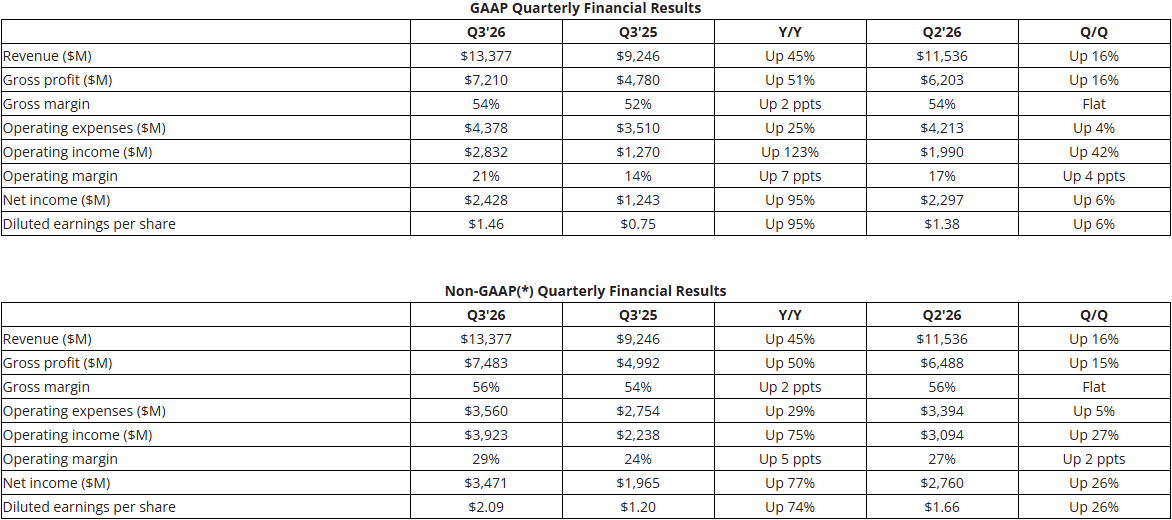
AMD (NASDAQ:AMD) today announced financial results for the third quarter of 2026. Third quarter revenue was $13.4 billion, gross margin was 54%, operating income was $2.8 billion, net income was $2.4 billion and diluted earnings per share was $1.46. On a non-GAAP(*) basis, gross margin was 56%, operating income was $3.9 billion, net income was $3.5 billion and diluted earnings per share was $2.09.
“We delivered a record quarter with revenue exceeding the high end of our guidance as Data Center segment sales nearly doubled year-over-year,” said Dr. Lisa Su, AMD chair and CEO. “Demand for our Instinct and EPYC products continued to strengthen, and we expect growth to accelerate further in the fourth quarter as we scale Helios and ‘Venice’ production. With our leadership product portfolio and deep customer and supply chain relationships, we are confident in our ability to sustain very strong revenue growth and expanding profitability over the coming years.”
“Third quarter revenue grew 45% year-over-year to a record $13.4 billion, while non-GAAP earnings per share grew 74%, demonstrating the significant operating leverage in our business model as our Data Center business drives scale,” said Jean Hu, AMD executive vice president, chief financial officer and treasurer. “Our fourth-quarter outlook reflects accelerating revenue and earnings growth, driven by strong demand across our Data Center portfolio.”
Segment Summary
- Data Center segment revenue was a record $8.5 billion, up 97% year-over-year, driven by strong demand for AMD EPYC™ processors and the launch of AMD Instinct™ MI450 Series GPUs.
- Client and Gaming segment revenue was $3.7 billion, down 8% year-over-year. Client business revenue was $2.9 billion, up 7% year-over-year, driven by sales of AMD Ryzen™ mobile processors. Gaming business revenue was $773 million, down 40% year-over-year, due to lower semi-custom and graphics revenue.
- Embedded segment revenue was $1.1 billion, up 29% year-over-year, led by growth in aerospace and defense, automotive, communications and industrial end markets.
Recent Highlights
- AMD solutions and software are powering superintelligence infrastructure at scale:
- Anthropic, Meta, Microsoft, OpenAI and Oracle Cloud Infrastructure are running models and workloads on the first AMD Helios™ rackscale solutions, powered by AMD Instinct MI450 Series GPUs and 6th Gen AMD EPYC CPUs.
- HPE announced that Vultr will deploy the first AMD Helios by HPE systems.
- Oracle Cloud Infrastructure announced its OCI Compute E7 cloud compute instances will be powered by 6th Gen AMD EPYC CPUs, supporting enterprise applications and the CPU services surrounding models.
- AMD introduced the AMD Helion reference architecture, an open, flexible blueprint for building rack-scale agentic systems that lets customers configure the mix of CPUs and GPUs based on their workloads.
- AMD ROCm™ 10 was released, bringing AI-native developer experiences to AMD platforms with ROCm.AI, along with performance improvements and updated libraries, compilers, frameworks, tools and model support.
- The EuroHPC JU selected AMD Instinct MI430X GPUs and 6th Gen AMD EPYC processors to power the LUMI-AI supercomputer.
- Google Cloud and Microsoft announced general availability of storage-optimized cloud instances powered by 5th Gen AMD EPYC CPUs.
- AMD is expanding its capabilities across the full superintelligence stack through strategic acquisitions:
- AMD announced an agreement to acquire World Labs, bringing leading model research expertise to AMD to help shape superintelligence infrastructure and strengthen the open ecosystem.
- AMD announced an agreement to acquire Taalas, adding specialized inference silicon technology to further differentiate AMD system-level solutions and deliver breakthrough inference performance and efficiency.
- AMD advanced its adaptive and embedded portfolio and expanded its role in physical AI systems:
- AMD began sampling the AMD Versal™ AI Core XQRVC1902 space-grade adaptive SoC designed to support missions lasting up to 15 years.
- Kodiak AI announced that its next generation autonomous truck platform is powered by AMD EPYC processors.
- AMD introduced AMD Ross™, an agentic tool for embedded system design that helps customers accelerate time to market and improve performance for AMD embedded solutions.
- AMD expanded its PC offerings for local agentic superintelligence and gaming:
- The AMD Ryzen™ AI Halo platform powered by Ryzen™ AI Max PRO 400 Series processors is now available, bringing the performance, memory and software ecosystem developers and creators need to build and run models locally.
- HP, Lenovo, Framework and GMKtec expanded availability of systems powered by AMD Ryzen™ AI Max PRO 400 Series processors.
- AMD debuted the Threadripper Halo Station, powered by the AMD Threadripper 9955WX CPU and AMD Instinct MI350p GPU, able to run trillion-parameter models locally.
Current Outlook
AMD’s outlook statements are based on current expectations. The following statements are forward-looking and actual results could differ materially depending on market conditions and the factors set forth under “Cautionary Statement” below.
For the fourth quarter of 2026, AMD expects revenue to be approximately $17 billion, plus or minus 3%. The mid-point of the revenue range represents year-over-year growth of approximately 66% and a sequential increase of approximately 27%. Non-GAAP gross margin is expected to be approximately 55%.





Neueste Kommentare
3. November 2026
1. November 2026
21. Oktober 2026
21. Oktober 2026
18. Oktober 2026
18. Oktober 2026