(Auszug aus der Pressemitteilung)
Arm delivered a record first quarter, reflecting strong execution across our business and growing demand for the Arm compute platform as AI expands across cloud infrastructure, edge devices and the physical world.
Revenue reached $1.29 billion, up 22% year over year, driven by record first-quarter licensing and royalty revenue. Royalty revenue grew 22% to $715 million, with data center royalties more than doubling year over year. Licensing revenue reached $574 million, up 23% year over year. Combined with continued investment in R&D, non-GAAP EPS grew 29% year over year to $0.45, above the top end of our guidance range.
These results reflect two important trends. First, the transition of the data center to Arm continues to accelerate, creating significant opportunities for Arm technology through both Arm AGI CPU silicon and IP royalty revenue. Second, AI is rapidly expanding beyond the cloud into edge devices like PCs and smartphones, and into physical AI systems such as vehicles and intelligent robotics, increasing demand for the Arm compute platform across a broad range of devices.
Arm AGI CPU Is Exceeding Initial Expectations
In March, we introduced the Arm AGI CPU, expanding Arm into production silicon, giving customers another way to deploy the Arm compute platform. Since then, we have continued to make strong progress. Initial product has been delivered to multiple customers, and we have secured the manufacturing capacity required to support the $1 billion opportunity we outlined last quarter across fiscal 2027 and fiscal 2028.
Customer demand has accelerated beyond our initial expectations and now exceeds $2 billion across fiscal 2027 and fiscal 2028. Since launch, we’ve continued to add new customers, including multiple customers in the US & China, while the overall value of our pipeline has continued to strengthen. We’re also working closely with our manufacturing and supply chain partners to expand capacity. Our confidence in achieving upside to our $1 billion opportunity has increased in the past 90 days.
Transition of the Data Center to Arm Continues to Accelerate
Momentum for Arm AGI CPU reflects a broader transition already underway across our Neoverse business. During the quarter, data center royalties more than doubled year over year as adoption of Arm Neoverse continued to expand. Arm Neoverse shipments have now surpassed 1.5 billion cores, with the most recent 500 million shipping in just nine months, where the first 1 billion took 6 years, reflecting Arm’s growing market share and increasing value capture.
That momentum extends across the broader AI ecosystem. NVIDIA announced that Vera has entered full production. Built on Arm, Vera delivers up to 50% higher CPU performance and 2x greater energy efficiency than comparable x86 systems and will serve as the CPU foundation for NVIDIA’s next-generation AI infrastructure, with deployments planned across leading AI cloud providers and server platforms. Google has stated that its Arm-based Axion CPU is a core component of its AI infrastructure strategy, highlighting its role as the host CPU for Google’s latest TPU AI systems. AWS also expanded momentum behind its Arm-based Graviton platform, announcing a multi-year agreement with Meta to deploy tens of millions of Graviton5 cores to power agentic AI workloads. Microsoft expanded Azure Cobalt 200 virtual machines built on Arm Neoverse CSS. And Qualcomm has announced plans to enter the AI data center CPU market with its Arm-based Dragonfly C1000. Together, these milestones reinforce that the world’s leading AI infrastructure providers are increasingly building the next generation of AI infrastructure on Arm.
Independent industry data reinforces this momentum. IDC recently reported that spending on Arm-based accelerated server platforms has nearly doubled in the past two quarters and has surpassed x86 platforms, underscoring the industry’s transition toward Arm for AI infrastructure. IDC also raised its 2026 AI infrastructure spending forecast to almost $500B. As AI infrastructure investment continues to grow, Arm’s opportunity to capture increasing value continues to expand.
As Agentic AI Expands Beyond the Data Center, Arm’s Platform Advantage Grows
The same factors reshaping AI infrastructure are also redefining computing beyond the data center. As AI becomes increasingly agentic, the economics of AI are becoming just as important as model capability. Deploying AI at scale across the cloud, the edge and, ultimately, the physical world requires efficient compute to improve performance, reduce latency, enhance privacy and lower infrastructure costs. This plays directly to Arm’s strengths in delivering efficient, high-performance compute across billions of devices.
The result is a new generation of computing devices spanning two distinct categories – efficient, on-the-go AI PCs and high performance, agentic platforms. During the quarter, NVIDIA introduced RTX Spark, the first agentic PC built on Arm Compute Subsystems (CSS), enabling sophisticated AI agents and larger AI models to run locally, bringing agentic AI directly to developers and creators. Systems based on RTX Spark are expected to be available later this year from leading OEMs including Acer, ASUS, Dell, HP and Lenovo, demonstrating broad ecosystem support for this new category of Arm-based computing. For on-the-go AI PCs, those same OEMs continued expanding the Windows on Arm ecosystem with new Qualcomm Snapdragon-powered AI PCs, while Google’s continued investment in AI enabled Chromebooks broadens access to on-device AI across the PC market. Together, these milestones reinforce Arm’s expanding opportunity as AI drives the transition to the next generation of personal computing.
The same economics are extending into the physical world. Vehicles, robots, industrial systems and autonomous machines require efficient, secure and real-time compute to sense, reason and act autonomously. NVIDIA recently expanded its physical AI platform with Cosmos 3 and the Isaac GR00T humanoid robotics platform, powered by Jetson Thor, which combines an Arm-based CPU built with NVIDIA Blackwell GPU. As AI moves beyond the data center into billions of intelligent machines, Arm’s compute platform is the CPU foundation for physical AI.
Arm’s Platform Is Uniquely Positioned for the AI Era
For more than three decades, Arm has been building the world’s leading compute platform and enabling an ecosystem that allows our partners to innovate faster. Arm’s software ecosystem also continued to expand, now supporting more than 22 million developers worldwide. During the quarter, Arm introduced Performix, with support from Microsoft, MongoDB, Redis and SAP, helping developers and AI agents analyze and optimize workloads running on Arm-based infrastructure. Arm also expanded its AI developer tools, including the Arm MCP Server, which surpassed 10,000 Docker downloads and integrates Arm expertise into leading AI developer environments. These investments make it easier for developers to build, deploy, and optimize software on Arm across cloud, edge, and physical AI.
The opportunity ahead extends well beyond any one product or market. As AI becomes part of every cloud, every device and every sector, the industry is increasingly converging on a common compute platform. Whether customers adopt Arm through IP, CSS or silicon, they are building on the same platform, software ecosystem and developer community. We believe that convergence will define the next decade of computing.
“Arm delivered a record first quarter, with data center royalties more than doubling year over year as the transition of AI infrastructure to Arm continued to accelerate. Demand for the Arm AGI CPU has continued to exceed our initial expectations, and our continued work to expand manufacturing capacity with our partners gives us increasing confidence that we can deliver at the scale our customers require.” – Rene Haas, CEO, Arm
Q1 FYE27 Financial Overview
- Arm’s Q1 results demonstrated strong year-over-year revenue growth. Total revenue increased 22% year-overyear to $1,289 million, representing another record quarter for revenue.
- Royalty revenue increased 22% year-over-year to $715 million, driven by the continued adoption of Arm technology with higher royalty rates per chip, such as Armv9 architecture and Arm CSS, and increased deployment of Arm-based chips in data centers.
- License and other revenue increased 23% year-over-year to $574 million driven by continued strong demand for Arm IP, as well as fluctuation in the timing and size of multiple high-value license agreements and contributions from backlog.
- Annualized contract value (ACV), a metric for normalized license and other revenue, increased 13% year-overyear to $1,732 million.
- GAAP gross profit was $1,253 million, which equates to a GAAP gross margin of 97.2%. Non-GAAP gross profit was $1,264 million, which equates to a non-GAAP gross margin of 98.1%.
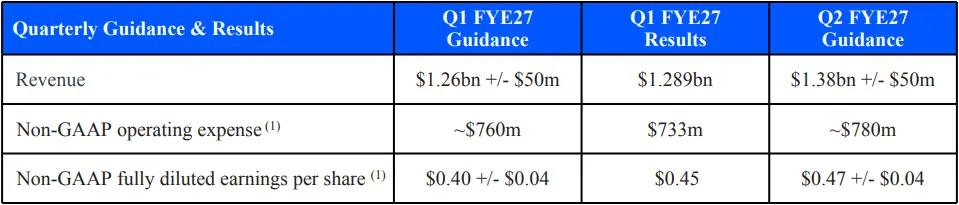
- GAAP operating expenses were $1,162 million. Non-GAAP operating expenses were $733 million and increased 18% year-over-year.
- GAAP research and development was $838 million. Non-GAAP research and development was $530 million and increased 20% year-over-year driven primarily by investment in engineering headcount and other expenses.
- GAAP selling, general and administrative was $317 million. Non-GAAP selling, general and administrative was $203 million and increased 13% year-over-year driven primarily by staff costs and other expenses.
- GAAP operating income was $91 million. Non-GAAP operating income was $531 million.
- GAAP operating margin decreased to 7.1% from 10.8% in the prior year period. Non-GAAP operating margin increased to 41.2% from 39.1% in the same period a year ago.
- GAAP net income was $270 million and GAAP fully diluted earnings per share („EPS“) was $0.25 compared with $0.12 in the same period a year ago. Non-GAAP net income was $480 million and non-GAAP fully diluted EPS was $0.45 compared with $0.35 in the same period a year ago.
- Operating cash flow was $902 million and non-GAAP free cash flow (FCF) was $665 million, benefiting from favorable timing of receivables collections and tax payments.
- Cash and cash equivalents and short-term investments totaled $3,888 million
Guidance and Results




Neueste Kommentare
12. September 2026
4. September 2026
4. September 2026
2. September 2026
2. September 2026
31. August 2026