(Auszug aus der Pressemitteilung)
Arm (NASDAQ: ARM) published a letter to its shareholders containing the company’s results for the third quarter of fiscal year 2026 ended December 31, 2025.
Here are what the results mean and how they were achieved:
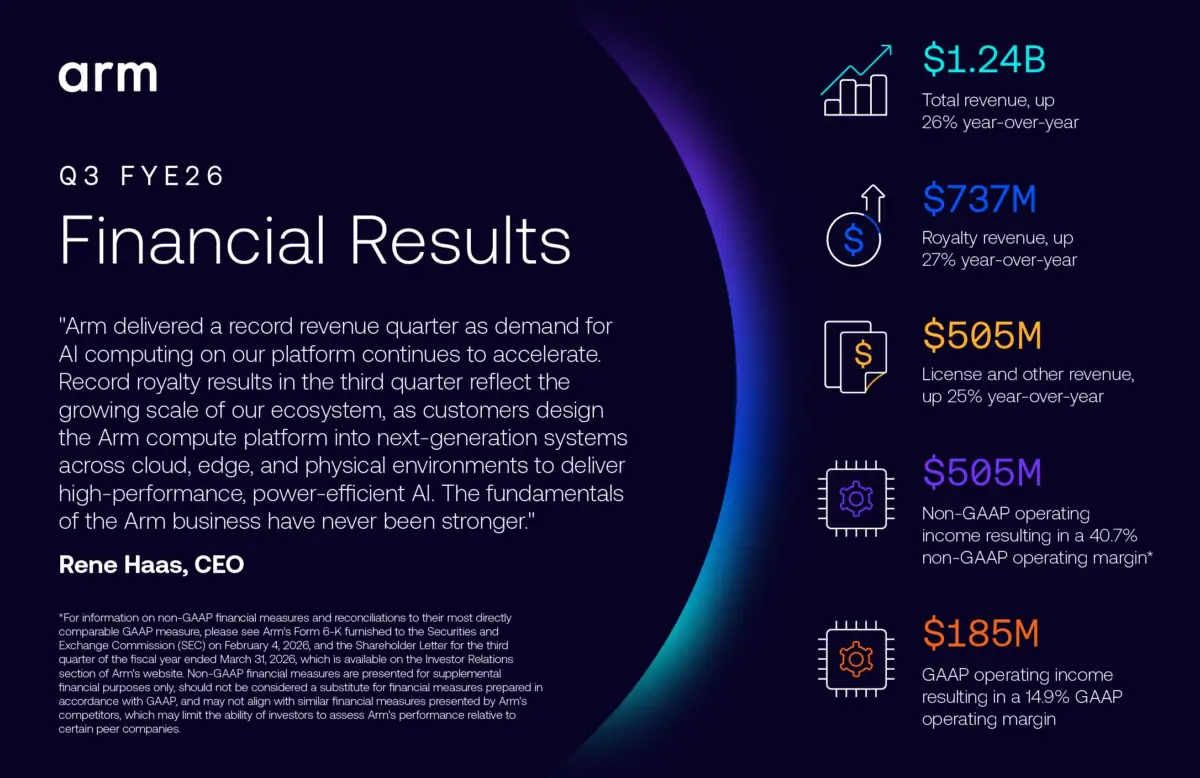
- Revenue grew 26% year-on-year to $1.24 billion, representing Arm’s fourth consecutive billion-dollar revenue quarter.
- Royalty revenue grew 27% year-over-year to a record $737 million, driven by growth across Arm’s target end markets, including AI and general-purpose data center, smartphones, physical AI and edge AI.
- License and other revenue of $505 million increased 25% year-over-year, as more leading companies sign high-value licenses for next-generation Arm technologies.
- Demand for Arm Compute Subsystems (CSS) continues to exceed expectations as adoption grows in light of increasingly complex chip designs. This represents a significant tailwind to royalty growth, as Arm expands both the value deliveredand economics captured per chip.
- During the quarter, Arm signed two CSS licenses for use in both edge AI tablets and smartphones, bringing the total number of CSS licenses to 21 across 12 companies.
- Additionally, five customers are now shipping Arm CSS-based chips, including two shipping its second-generation platform, while the top four Android smartphone vendors are all shipping Arm CSS-powered devices.
- As AI systems become increasingly agent-based and distributed across cloud, edge, and physical environments, the industry requires platforms that deliver performance, efficiency, and consistency across a wide range of use cases and power envelopes. Arm uniquely delivers this foundation, with the Arm compute platform spanning milliwatts to gigawatts across the industry’s broadest set of markets, supported by the world’s largest developer ecosystem featuring over 22 million developers, which represents more than 80% of the global total.
- The shift towards agent-based inference is redefining AI data center designs, as demand increases for CPU chips with an even higher number of power-efficient cores. As a result, Arm’s role at the center of modern data center architectures continues to grow, with Arm-based CPU chips delivering industry-leading performance-per-watt that enable partners to scale core counts and run always-on AI workloads efficiently.
- Arm Neoverse CPUs have now surpassed one billion cores deployed and Arm’s share among top hyperscalers is expected to reach nearly 50%. The leading hyperscalers are launching new products with increased core counts.
- AWS launched its fifth-generation Graviton processor, built on the higher performance Arm Neoverse CSS V3, which features 192 cores, doubling the core count from Graviton4.
- NVIDIA launched its next-generation Vera CPU, which features 88 Arm-based cores, up from 72 cores in the Grace CPU generation.
- Microsoft launched its next generation Cobalt 200 silicon, built on Neoverse CSS V3, which features 132 cores, up from 128 cores in Cobalt 100.
- The Arm compute platform enables tightly integrated system designs that scale AI more efficiently, so customers can deploy more AI applications within the same power and cost envelope.
- AWS integrates Graviton CPUs with Arm-based Nitro DPUs and Trainium accelerators to deliver system-level efficiency, while preserving customer flexibility.
- NVIDIA’s AI platforms pair their GPUs with Arm-based Grace CPUs and Arm-based Bluefield DPUs, with the transition to the new Arm-based Vera platform delivering a 6x increase in DPU compute capability over the prior generation.
- Arm’s compute platform delivers excellent power efficiency and predictable latency, alongside a common software foundation that scales across consumer devices, vehicles, and robotics. This allows edge and physical AI partners to deploy AI systems across multiple form factors without rebuilding software stacks, supported by the world’s largest developer ecosystem.
- In December 2025, Rivian announced its third-generation Autonomy Computer built on the Arm-based Rivian Autonomy Processor, which will power their first production vehicle based on a custom Arm chip and be the first to deploy Armv9 in a production car.
- Tesla’s upcoming Optimus humanoid robot is powered by a custom Arm-based AI processor, underscoring Arm’s role at the forefront of physical AI.
- The broader robotics and autonomous systems market is scaling through Arm-based platforms from leading silicon providers, including NVIDIA’s Jetson Thor platform and Qualcomm’s Dragonwing platform, that reinforce Arm as the common compute foundation for the physical AI ecosystem.
- In Chromebooks, OEMs – including Lenovo and Acer – are deploying Arm-based designs from entry level systems through to the premium Chromebook Plus category, with this trend driven by Arm’s performance-per-watt advantage versus x86, translating into several additional hours of battery life.
The infographic below provides the key highlights:





Neueste Kommentare
27. Juli 2026
23. Juli 2026
23. Juli 2026
21. Juli 2026
18. Juli 2026
17. Juli 2026