(Auszug aus der Pressemitteilung)

In the first blog of this two-part series, Omdia explores how rising DRAM and NAND prices are reshaping smartphone economics, putting particular pressure on mid-to-low-end devices and accelerating the decline of smartphones priced below $400.
The second blog will examine how these cost pressures are deepening memory polarization across the smartphone market, with vendors cutting or freezing memory capacity in lower-end devices while continuing to upgrade premium models.
According to Omdia’s latest research, both DRAM and NAND prices have increased sharply over recent quarters and are expected to continue rising. Memory costs have become a serious burden for mid-to-low-end smartphones, contributing to a year-on-year decline of over 22% in the market for smartphones priced below $400.
Source: Quarterly Smartphone Technology Trends – 1Q26 Analysis Premium
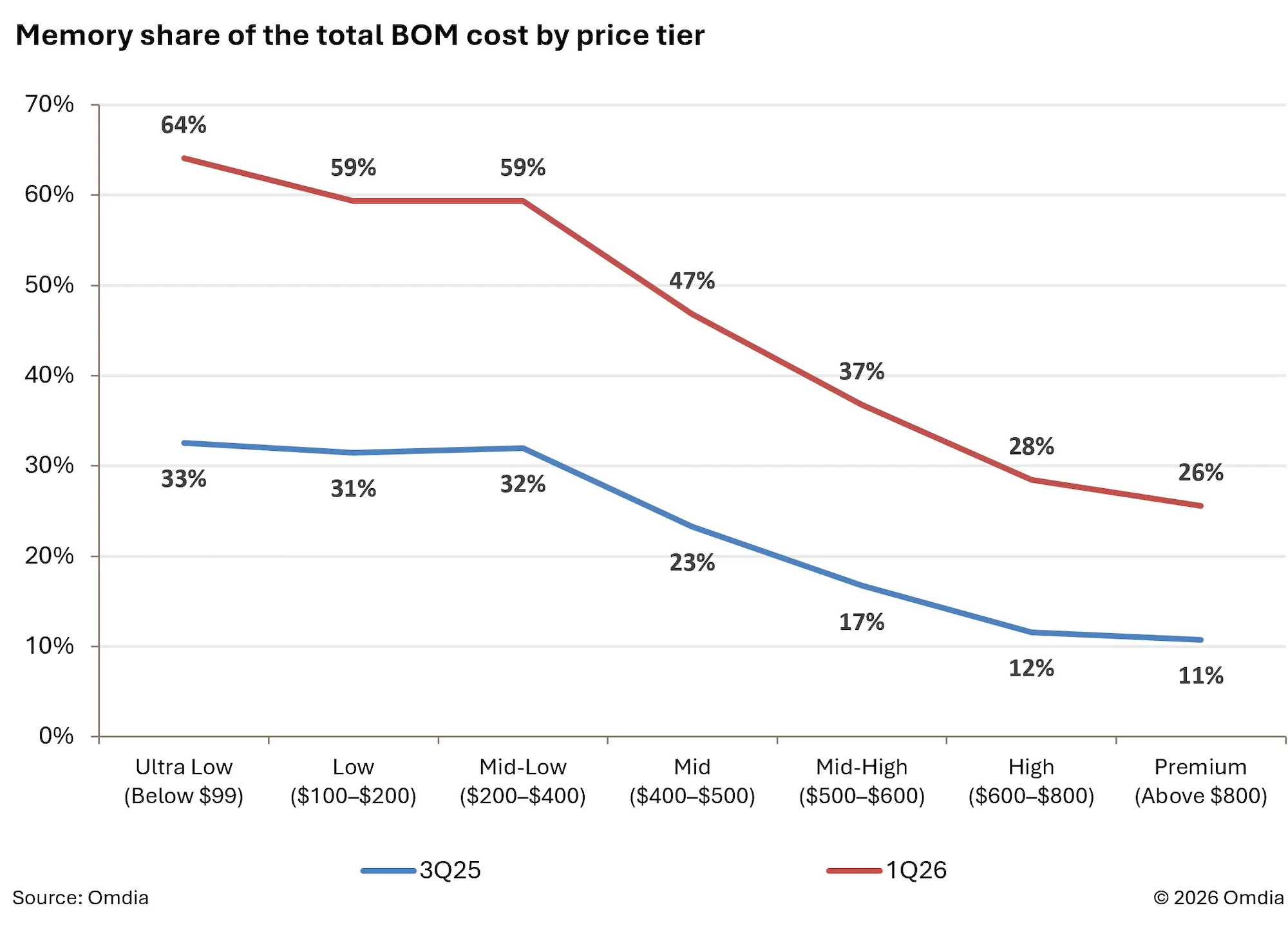
As memory prices have continued to rise rapidly since last year, the cost structure of smartphones has undergone a significant swift. Compared with the BOM cost structure between 3Q25 and 1Q26, the memory cost share in 1Q26 nearly doubled in the sub-$400 price segment and increased by more than 100% in products priced above $400, according to report from Quarterly Smartphone Technology Trends – 1Q26 Analysis Premium.
In 1Q26, memory costs already accounted for nearly 60% of the total BOM cost in smartphones priced below $400, and even exceeded 64% in products priced below $99. Smartphone vendors are trying to offset some of the pressure from rising memory costs by reducing the cost of other components, such as display panels, sensors, radio frequency (RF) modules, where supply remains abundant. However, low-end smartphones are already designed around extremely tight cost structure, making it difficult to offset higher memory costs by cutting costs elsewhere.
Memory costs have become a serious burden for low-end smartphones. Zaker Li, Principal Analyst from consumer team of Omdia noted that the situation will worsen as memory prices continue to rise in the coming quarters. Smartphone vendors such as Transsion, OPPO, vivo, Honor and Xiaomi significantly raise the retail price of their products only to maintain thin profit margin.
However, higher prices are likely to lead to a significant decline in demand, as low-end consumers are highly price-sensitive. Based on the memory price trend for the coming quarters, low-end products are already becoming unprofitable and face a high risk of weakening demand as retail price continues to rise. As a result, smartphone vendors are proactively and gradually retreating from the low-end segment in this year.
According to Omdia’s latest forecast in May, global smartphone market will decline by 12% year-over-year in 2026, due to the significant drop in smartphone shipments priced at $400 and below, which are expected to decline by more than 22% this year.
By contrast, smartphone shipments above $400 will remain resilient and are expected to grow by 5.7% in 2026. This reflects three key factors:
- Smartphone vendors are shifting their focus to mid-to-high-end products.
- Continued retail price increases are expanding the share of products above $400.
- High-end consumers are less price-sensitive, helping to sustain stable demand.
Vendors have more room to reduce costs in the mid-high-end premium segment. The memory cost share in smartphones priced above $400 falls rapidly as product prices rise, especially for products priced above $600, where higher-specification System on a Chip (SoC), displays, and camera modules account for a larger share of the total BOM. Smartphone vendors can reduce cost across these specifications to relieve some of the memory costs burden:
Display: Chinese smartphone vendors are returning to LTPS OLED panel in some high-end models that had previously upgraded to LTPO display, while keeping LTPO technology mainly for the premium models. This can save around $3 to $5 per device.
Camera module: Vendors can adopt more flexible configurations, depending on each product’s positioning, such as using smaller image sensors or reducing the number of cameras.
SoC: SoC remains the largest cost component in smartphones priced above $600, vendors can slow down the pace of upgrades by using previous-generation platforms, potentially reducing costs by around 30% to 40%.
As memory costs continue to reshape smartphone economics, vendors will need to balance affordability, profitability, and product competitiveness more carefully.




Neueste Kommentare
6. Oktober 2026
3. Oktober 2026
2. Oktober 2026
1. Oktober 2026
12. September 2026
4. September 2026